Thursday, 25 September 2014

Biology - Heart anatomy

STRUCTURE
FUNCTION
DEOXY/OXY BLOOD
LEFT ATRIUM
- collects oxygen-rich blood returning from the lungs
-forces it through the mitral valve and into the left ventricle
oxy
LEFT VENTRICLE
- largest and strongest chamber in the heart
- wall is only 1/2 inch thick
- has enough force to push blood through the aortic valve and into your body
oxy
RIGHT ATRIUM
- collects oxygen-poor blood returning from the body
-forces it through the tricuspid valve and into the right ventricle 
deoxy
RIGHT VENTRICLE
- collects oxygen-poor blood returning from the right atrium
-forces it through the pulmonary valve and into the lungs
deoxy
PULMONARY ARTERY
-carry blood from heart to lungs and picks up oxygen
deoxy
AORTA
-largest artery
- carries oxgen-rich blood from heart to entire body
oxy
PULMONARY VEINS
-carry oxygen-rich blood from lungs to heart
oxy
SUPERIOR VENA CAVA
-oxygen-poor blood from the upper parts of the body returns to the heart through the superior vena cave
deoxy
INFERIOR VENA CAVA
-oxygen-poor blood from the lower parts of the body returns to the heart through the superior vena cave
deoxy
ATRIOVENTRICULAR VALVES (Mitral & Tricuspid)
-tricuspid controls blood flow from the right atrium to the right ventricle 
-mitral controls flow from the left atrium to the left ventricle
deoxy/oxy
CHORDAE TENDINAE
- bring right ventricular walls closer together during contraction
 -pull the AV Valves open during atriole systole
left oxy
right deoxy
SEMI LUNAR VALVES (Pulmonary & Aortic)
-pulmonary valve control blood flow from right ventricle to the pulmonary arteries
- aortic valve controls blood from left ventricle to aorta
deoxy/oxy
SEPTUM
sperates left from right


-Coronary arteries and veins are the blood vessels that supply blood and carry blood away from the heart muscle. The left coronary arteries supply blood mainly to the left side of the heart and vice versa.  

workout 1

shoulder press: 12reps '80, 10 reps' 90, 8 reps'100,
tricep over head extension: 12reps'45, 10reps'50, 8 reps'50
bicep cable curl: 12reps'100, 10 reps'110, 8reps'120
Bicep bar curl: 3 sets, 10reps'10
Bike: 20 minutes

Tuesday, 23 September 2014

Why are we blogging?

Why did you take the co-op?
I took co-op because I want to further my experience in human kinetics and want to know more about the human body.


What are your plans for next year?
I intend on going into university and take lots of business classes and explore my options.


What activities do you like to do outside of school?
I like to play soccer, and many different sports outside of school.


Have you done any fitness activities over the summer?
Yes, I played lots of soccer over the summer and worked out.


What are your fitness goals for the semester?
improve my stamina and become as fit as possible.


Add any pictures/you tube links/etc., that help you show what you like and who you are.
What is important to you & helps to define who you are?
https://www.youtube.com/watch?v=GOtxJrzp6ls


Monday, 20 January 2014

Finding Nemo

I have seen finding nemo many times before as a kid. Watching it when I was bored and thinking about how funny it was. I didn't realize anything that actually had to do with nature besides the general stuff. When I watched it this time I was trying my hardest to try and find new things that I had not discovered before. The first thing I had realized was the clown fishes habitat. I thought about how they survived in that habitat and the requirements they needed in order to survive. After thinking about that I realized the flat worm which I had never even realized in the film before and didn't remember. Another part I saw differently was the part of how the deep sea was separated from where the small fish lived and how they were scared to go there. I now realize that they cannot go into the deep sea because they wouldn't be able to survive in a new habitat. I wonder about many things in this movie. Like do fish know who humans are? are they scared of us? can they even communicate with each other and if so then how?

Second Final Question

Celebrity Organisms- http://kelvanmangat.blogspot.ca/2013/11/celebrity-organisms-adolf-hitler.html
This blog was naming an organism that was named after a celebrity. Mine was Anophthalmus Hitleri which was named after Adolf Hitler.

Amazing Organisms- http://kelvanmangat.blogspot.ca/2013/10/blood-shooting-lizard.html
http://www.youtube.com/watch?v=gEl6TXrkZnk
This was my amazing organism and it was amazing because it was a lizard that shoots blood out of its eye to protect itself. This lizard is called a horned lizard.

Amazing/Interesting Plants- http://kelvanmangat.blogspot.ca/2013/11/extreme-plant.html
The leaf of Darlingtonia is unique: it is tubular, and contains a fluid that digests trapped insects.

Interesting Cnidarians- http://kelvanmangat.blogspot.ca/2013/12/sponge.html
Sponges are animals of the  Porifera

Interesting Arthropods- http://kelvanmangat.blogspot.ca/2014/01/hercules-beetle.html
The Hercules beetle is a species of rhinoceros beetle that lives in South America. This beetle is the STRONGEST ANIMAL

I believe my best blog post out of these was the horned lizard. This was the lizard that shoots blood out of its eye. I chose this blog post because I believe it is the most interesting and unique one and I had a lot of fun learning about it and presenting it to the class. I learned that the horned lizard does not only shoot the blood out of its eye but it travels a length up to three feet (one meter). It also contains a chemical that is noxious to dogs, wolves, and coyotes. The thing that stands out about this post is how to the blood is poisonous and scares away and even kills predators. I chose 2. Requirements & Characteristics of Living Things. This lizard requires the blood to survive in its natural habitat and to get food for itself in able to have a healthy life. Nature has evolved and helped this animal defend itself in this way.
 

First final question

Within the animal kingdom we have dissected a roundworm (phylum nematoda), an earthworm (phylum annelida), a grasshopper (phylum arthropoda), a starfish (phylum echinodermata) and a grass frog (phylum vertebrata, class amphibia).
I will be discussing each of these dissections.

Roundworm:


Feeding and Digestion
  • Roundworms have 2 openings(mouth and anus)
  • Mouth contains 3-6 rows of teeth
  • The food enters through the mouth, then into the pharynx, and then, the very long intestine. This extends all the way to the anus, where the food is eliminated.
Reproduction
  • These are the intestines from the roundworm
  • Male roundworms produce sperm in a long thin tube called the testes
  • Fertilization is internal
  • The female roundworm produces egg cells within the very thin, coiled ovary
  • Fertilization takes place inside of the female
Respiration, circulation, nervous system
  • Don't have a proper circulatory or respiratory system
  • Diffusion takes place in body walls
  • The 2 nerve cords in the roundworm are dorsal nerve cord and ventral nerve cord. They transmit impulses to various cells and tissues of their bodies
Earthworm:
 
 
Feeding/Digestion
  • 2 openings, mouth and anus
  • They use the pharynx to bring in the food, then the food passes the esophagus and goes into the crop, the gizzard grinds it up and moves the food into the large intestine.
Reproduction
  • Hermaphrodites(contain male and female parts)
  • Internal reproduction
  • clitellum is used in its reproduction
Respiration, circulation, nervous system
  • diffusion takes place in body wall.
  • contain spiracles instead of lungs
  • closed circulatory system
  • have series of muscular vessels called hearts
  • aortic arches pumps blood into other 2 vessels
  • dorsal blood vessels carry blood to front of the body
  • ventral blood vessels carry blood to the back of the body
  • primitive brain, ventral nerve cord receive info and control body
grasshopper:


Feeding/Digestion
  • 2 openings
  • uses mandible and two pairs of maxillae for feeding. 
  • 3 main digestive parts are foregut, midgut, and hindgut
Reproduction
  • internal reproduction
  • ovipositors store the eggs
  • newborns often shed skin(metamorphosis)
Respiration, circulation, nervous system
  • openings called spiracles that have tubes that are the respiratory system
  • no lungs
  • has a heart which circulates blood
  • open circulatory system
  • has a brain, nerve cord, and sensory organs
starfish:
feeding/digestion
  • Complete digestion system with a mouth , two stomachs, an intestine, and an anus
  • it uses its digestive glands called pyloric caeca
  • when feeding the starfish stomach pops out and sucks in the food
  • excretes waste through anus
reproduction
  • Hermaphrodites
  • external reproduction in water
  • reproductive organs calles gonads in its arms
  • reproduce asexually by Binary Fission
Respiration, circulation, nervous system
  • ampulla, which are bulbs on the inside of its arms used for respiration and circulation
  • no lungs
  • closed circulatory system
  • water vascular system
  • no brain
  • eyes on each arm 
Grass frog:
Feeding/digestion
  • very similar to us
  •  digestive system consists of a stomach, small intestine, large intestine, and anus
  • feed on insects such as flies, etc.
Reproduction
  • females have a thin string which is called the oviducts
  • Reproduction has to take place in water because tadpoles can only swim
  • external fertilization
Respiration, circulation, nervous system
  • has lungs
  • respiration also takes place through their skin
  • closed circulatory system
  • has a heart and many blood vessels
  • has a brain
  • nervous system is very similar to humans nervous system


Monday, 13 January 2014

frog dissection

These are all of the frogs organs labeled

These are the frogs organs

These are the frogs webbed feet

This is the frogs mouth

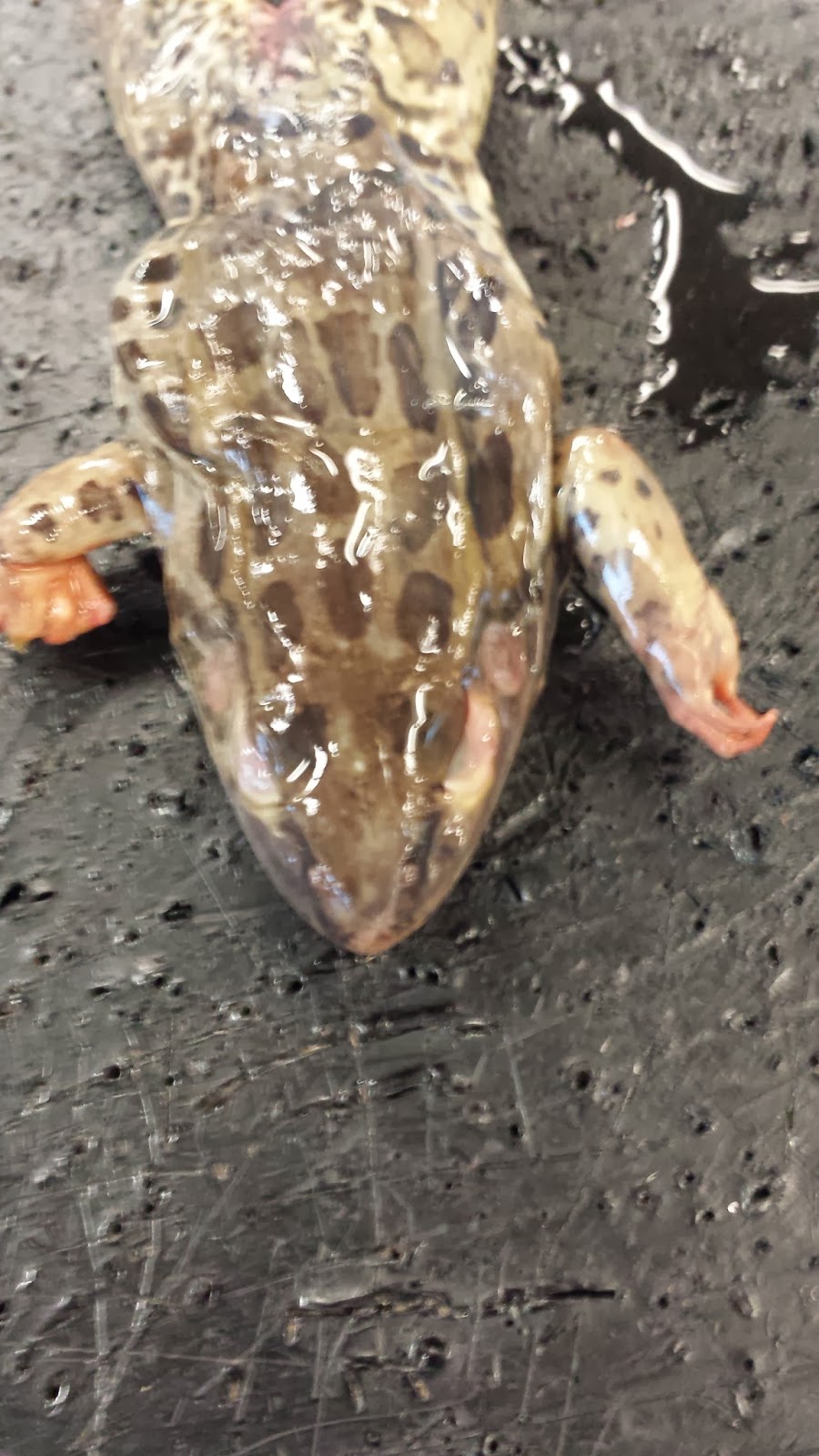
This is the top of the frog it was slimy with bumps and had black spots and lines with mostly greenish yellow skin

The bottom of my frog